Biosolids may be the hardest PFAS problem wastewater utilities have not yet solved.
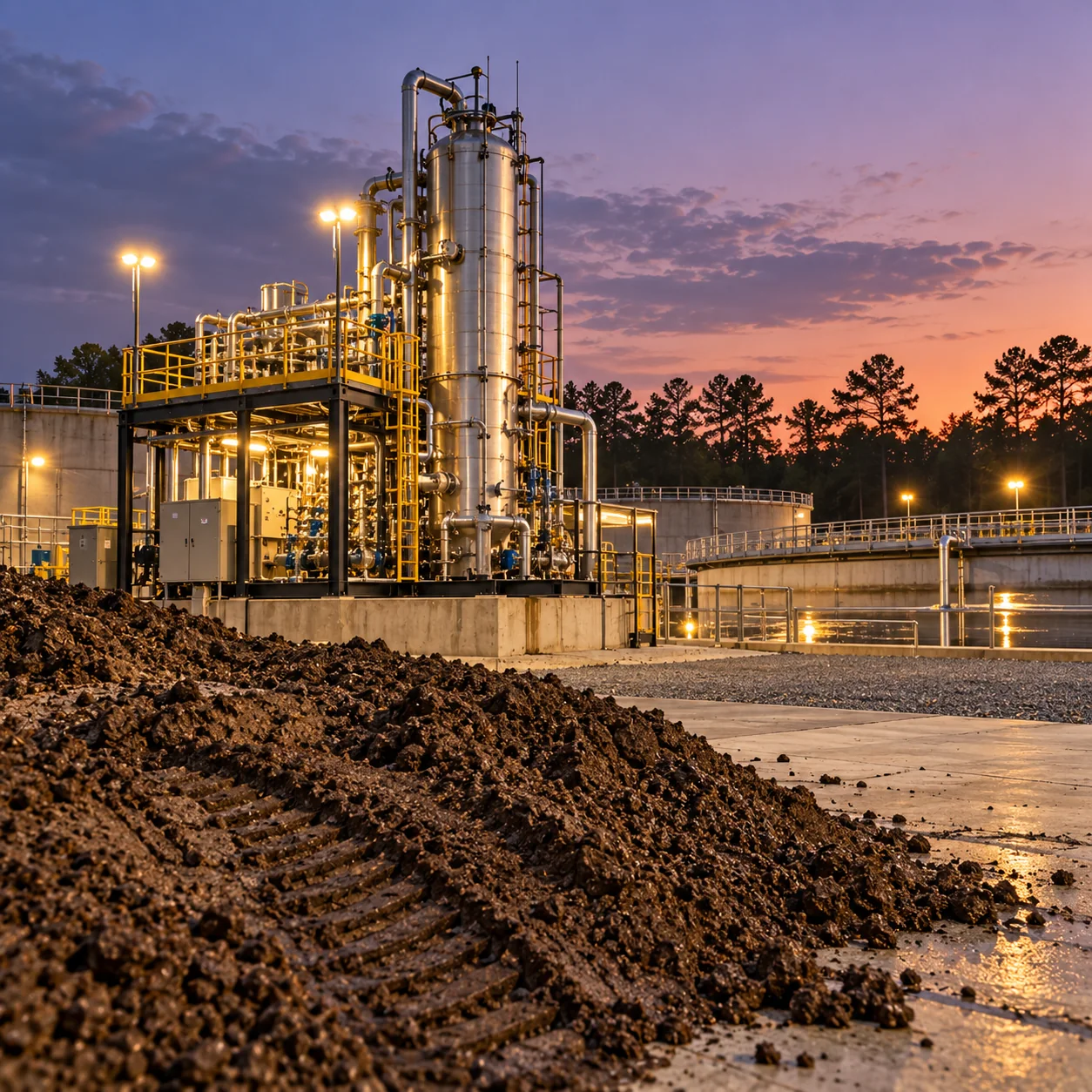
On September 22, 374Water, a Nasdaq-listed company based in Morrisville, North Carolina, said it will present new performance data for its AirSCWO supercritical water oxidation platform at WEFTEC 2026 in New Orleans. The headline figure, according to the company, is greater than 99.4% destruction and removal efficiency for every PFAS compound detected in a commercial-scale biosolids demonstration.
The same release reported results on other difficult streams. 6PPD-Q, a tire-derived contaminant, fell from 18 µg/L at the inlet to non-detect, a destruction and removal efficiency above 99.99%. Mixed pharmaceutical waste saw more than 99% reduction in chemical oxygen demand across variable feedstock blends, producing effluent compliant with the existing industrial site.
These are company figures rather than a regulatory finding, and the full dataset is scheduled for a podium presentation by technical solutions manager David Garb on September 30. Even so, the numbers arrive at a moment when utilities are looking hard for an exit route for PFAS that does not end in a farm field or a landfill cell.
Sludge Has Become the PFAS Pressure Point
Every PFAS removal step concentrates the problem somewhere. In wastewater treatment, a significant share of it ends up in the solids. For decades, those solids left the plant through land application, landfilling or incineration, and each route now draws closer scrutiny from regulators, farmers and the public.
EPA released draft guidance on July 1 offering voluntary recommendations for reducing risks from PFOA and PFOS in sewage sludge and biosolids. The agency aimed it at treatment plant operators, landowners, farmers and state and Tribal agencies. The document remains a draft, but its existence signals where expectations are heading.
Utilities increasingly want options that remove the liability instead of relocating it.
That is the market supercritical water oxidation is designed to serve.
One Platform for Many Contaminants Changes the Investment Case
Supercritical water oxidation treats wet waste at temperatures and pressures above the critical point of water, where organic compounds oxidise rapidly and completely. Because the process runs on wet feedstocks, it fits sludge naturally, and it breaks contaminants down instead of transferring them to another medium.
“What makes AirSCWO compelling is that one platform can destroy PFAS, 6PPD-q, pharmaceuticals, and other emerging contaminants without simply transferring the problem elsewhere,” said Sunny Viswanathan, vice president of solutions at 374Water.
That breadth matters commercially. A utility or industrial operator weighing a long-lived capital commitment wants equipment that handles PFAS today and whichever emerging contaminant regulators focus on next. A destruction asset that serves several waste streams is easier to finance than a single-purpose one.
The Biosolids Data Extends a Growing Commercial Record
The September data release is the latest step in a steady commercial build-out. In its first quarter results in May, 374Water reported a five-year agreement with the City of Orlando, with two five-year extensions, for a Waste Destruction Services facility. It also reported a purchase order through Garney Construction carrying $4.5 million in total contract value for the City of Olathe, Kansas, and a six-month mobile AirSCWO deployment in St. Cloud, Minnesota.
In July, 374Water signed a memorandum of understanding with Arcadis to jointly pursue federal and commercial PFAS destruction contracts, with Arcadis leading prime contracting and client relations. That agreement built on a Defense Department validation program run through the Defense Innovation Unit and the Environmental Security Technology Certification Program, in which AirSCWO achieved more than 99.9% PFAS destruction across hard-to-treat waste streams and more than 99.99% for concentrated firefighting foam, according to the companies.
“This agreement is designed to convert federal validation into commercial execution,” chief executive Danny Bogar said at the time.
The biosolids results carry that record from military foam into the municipal waste stream, where volumes are far larger and recurring.
What Utilities and Investors Should Measure Next
374Water puts the U.S. biosolids management market at more than $2 billion, and the company has said it expects its Orlando facility to generate $100,000 to $200,000 in monthly revenue initially, rising above $400,000 a month by late 2027. Arcadis and 374Water describe Orlando as the commercial reference hub for a regional treatment model.
Destruction efficiency is the entry ticket. Bankability depends on more. Utilities evaluating any biosolids destruction technology should be asking about:
- Cost per dry ton against landfilling, land application and incineration
- Throughput and uptime in continuous commercial operation, not short campaigns
- Independent verification of destruction data, including fluorine mass balance and off-gas results
- Management of effluent, salts and other residuals
- Contract structure: owned equipment, service agreements or regional hubs
- Alignment with state biosolids rules as they tighten
The answers will separate technologies that perform in a demonstration from those that can carry a utility’s sludge stream for twenty years.
Scale and Price Will Decide the Biosolids Market
The PFAS treatment industry spent its first decade getting good at capture. Granular activated carbon, ion exchange and membranes now pull PFAS out of drinking water at scale. The harder question has always been what happens to what they catch, and biosolids are where that question lands for most of the country’s wastewater plants.
A commercial-scale result above 99.4% does not settle that question on its own. It does show that full destruction of PFAS in sludge is moving from laboratory promise toward a service utilities can procure.
That shift opens room for regional treatment hubs, engineering partnerships and new service contracts built around destruction instead of disposal.
Capturing PFAS was the first chapter. Destroying it at a price utilities can pay is the one that comes next.