Tucson has turned a Superfund liability into part of its water supply strategy.
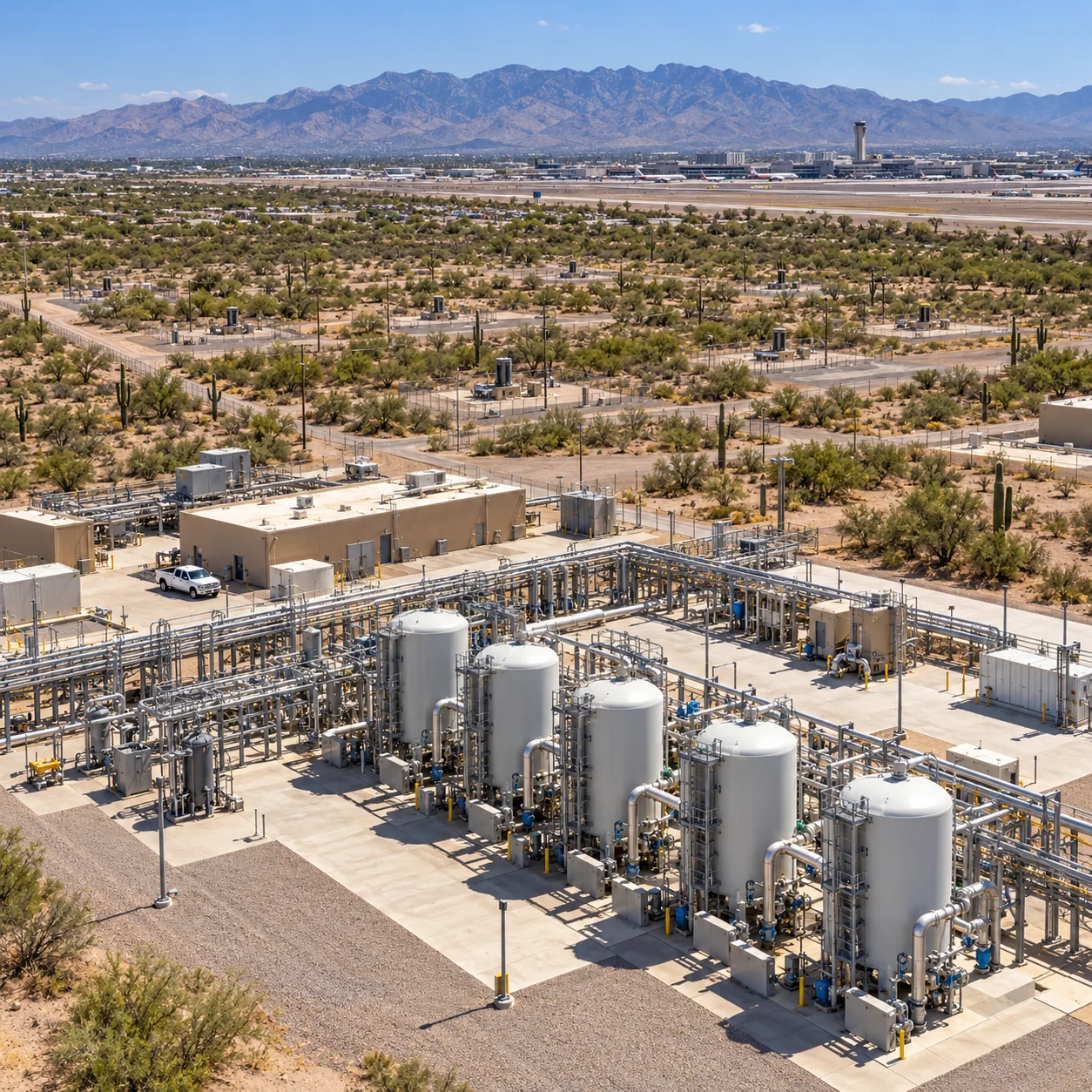
On September 1, Arizona Governor Katie Hobbs and Tucson Mayor Regina Romero cut the ribbon on an expanded treatment facility at the Tucson Airport Remediation Project, known as TARP. The $25 million expansion, funded through the American Rescue Plan Act, adds PFAS treatment to a plant that has been cleaning up the city’s south side aquifer for more than three decades. According to KGUN, officials say the system reduces PFAS to undetectable levels.
The timing matters. KGUN reports that Arizona faces a 30% reduction in Colorado River water allocations beginning January 1. In a desert city, groundwater that can be cleaned is groundwater that can be counted.
That changes how this kind of PFAS project should be read.
A Superfund Plant Adds Another Treatment Stage
The TARP story goes back a long way. Tucson Water discovered TCE contamination near Tucson International Airport in 1981, and EPA placed the site on the Superfund list in 1983, according to the city. The treatment plant was completed in September 1994. In 2014 the city added an advanced oxidation process to remove 1,4-dioxane and TCE.
PFAS was the next problem to solve. City records show the Arizona Department of Environmental Quality allocated $25 million to build a pretreatment system using ion exchange resin, with construction beginning in January 2025 and operation targeted for late summer 2026. The September ribbon cutting landed squarely inside that window.
That is the layered model many contaminated sites will need. Each new contaminant class adds a stage to proven infrastructure rather than demanding a new plant from scratch.
Water Stress Raises the Value of Every Treated Gallon
Tucson has been managing PFAS across its wider system for years. AZ Luminaria reported in June 2025 that 22 city wells had been removed from service because of PFAS contamination and 8 more placed on emergency use only status. The city depends on a sole-source aquifer, so every well carries strategic weight.
The expanded TARP plant does not solve that alone. For now, KGUN reports, the treated water serves parks and golf courses. But it protects local groundwater and keeps a significant resource available rather than written off.
What is a contaminated aquifer worth if it can never be used?
What is it worth once treatment is proven?
For utilities in water-stressed regions, the second answer is increasingly the one that shapes capital plans.
A Deliberate Path Back to Drinking Water
Tucson Water is not rushing. John Kmiec of Tucson Water told KOLD that now that the PFAS-specific treatment facility is constructed, the utility will be watching how the treatment works, describing a monitoring period of several years. Conversations about using the treated groundwater as drinking water are expected in 2029 to 2030, the station reports.
That patience is a strength. Years of performance data gathered under real influent conditions is what regulators, councils and ratepayers will want before treated Superfund groundwater returns to a potable system. It also gives operators time to understand resin life, changeout frequency and how concentrated residuals are handled.
That makes operating data the real product.
A Retrofit Template Other Utilities Can Copy
TARP shows a funding and delivery pattern others can replicate: one-time federal recovery money, channeled through a state environmental agency, applied to an existing remediation asset. Several lessons stand out for utilities and solution providers:
- PFAS pretreatment placed ahead of existing processes can be faster than building a new plant.
- Ion exchange remains a practical workhorse for municipal groundwater PFAS removal.
- Pairing remediation with supply diversification strengthens the case for public funding.
- Non-potable reuse offers a lower-risk first use while performance data builds.
- Community advisory boards shape how and when treated water returns to taps.
- Spent resin and residuals need a long-term management plan from day one.
For technology vendors, the opportunity extends beyond vessels and media. Multi-year validation periods create steady demand for monitoring, analytical services and, eventually, options for dealing with the concentrated PFAS that removal systems capture.
Community Trust Is Part of the Infrastructure
Yolanda Herrera, a member of the Unified Community Advisory Board, told KOLD her family has lived with the effects of contamination for more than 40 years. Her perspective is a reminder that south side residents measure progress in generations, not budget cycles.
Governor Hobbs framed the project as part of the state’s broader water security effort, saying Arizona cannot wait to secure long-term stability for its water future, according to KGUN.
Utilities across the Southwest face the same pairing of contamination history and supply pressure. Tucson’s sequence of treating now, proving performance and deciding later with the community gives them a workable template.
Tucson spent three decades cleaning its aquifer one contaminant at a time. The PFAS stage is what turns that cleanup into supply.