PFAS planning is turning into concrete and carbon.
On October 6, 2026, the Greensboro City Council in North Carolina voted unanimously to pay The Haskell Company roughly $260 million to upgrade PFAS treatment at the city’s Mitchell Water Treatment Plant, according to reporting by 88.5 WFDD and Smart Water Magazine.
Water Resources Director Mike Borchers said upgrading both the Mitchell and Townsend water treatment plants will cost $338 million in total. The improvements are scheduled to be finished by 2029.
It is a large commitment for a single utility, and it shows how utilities are moving from testing and debate to procurement and construction.
A Proven Technology, Chosen After Testing
Greensboro did not arrive at its choice quickly. Hoodline reports that the city ran a yearlong pilot-testing programme of multiple treatment options, which wrapped up in 2022, before selecting a granular activated carbon contactor system.
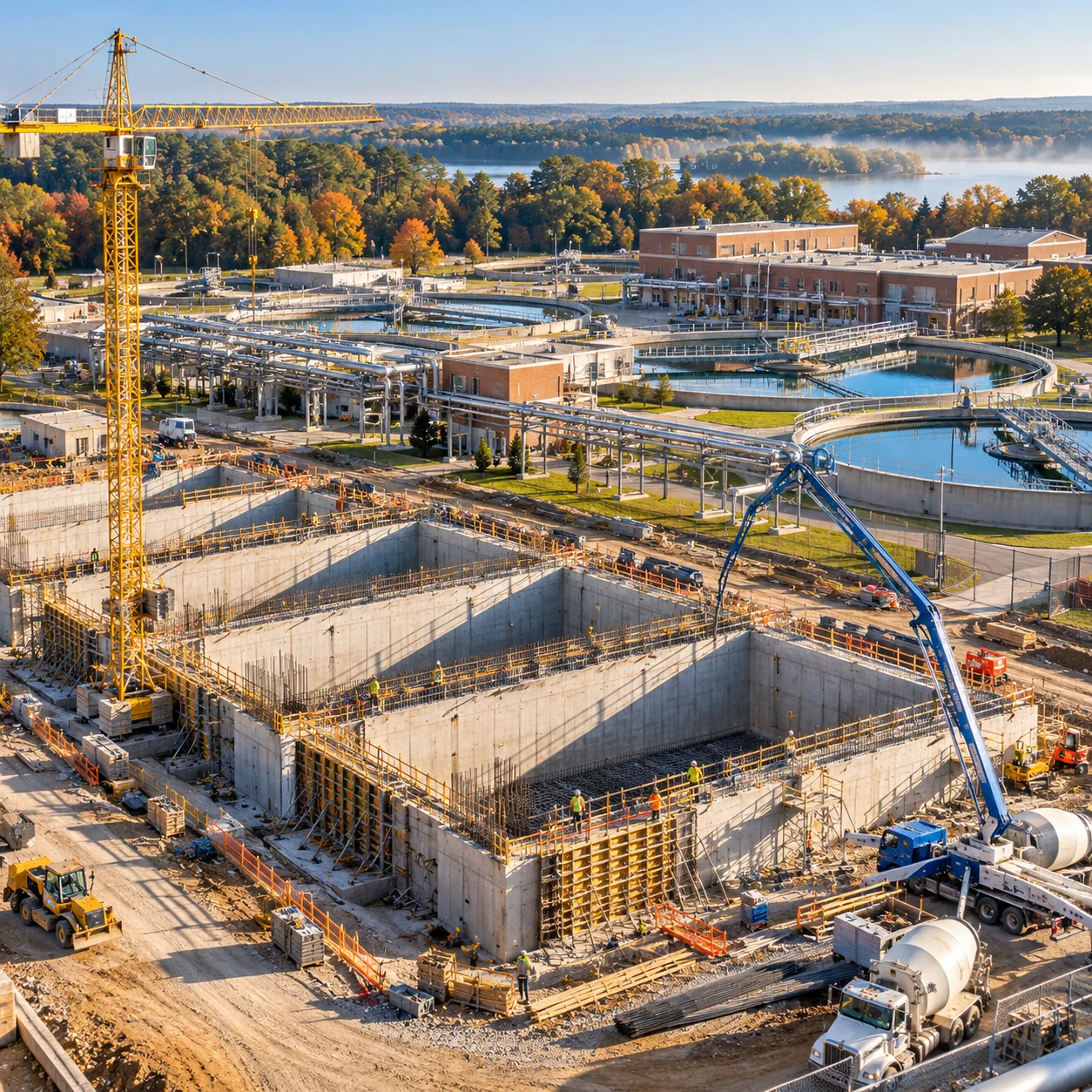
The design is simple to describe. Borchers explained that the new system relies on large concrete basins. “They’re filled with basically 15 feet of activated carbon, and the water trickles through,” he said, as quoted by Smart Water Magazine. He compared the approach to a household Brita filter, operating at municipal scale.
The city is confident in the results. Borchers said testing has shown “that that is a very effective technology and will remove it to near non-detect.”
That confidence matters.
Granular activated carbon is one of three approaches the US Environmental Protection Agency lists as effective at reducing PFAS in drinking water, alongside ion exchange resins and high-pressure membranes. It is familiar to operators, well understood by regulators and supported by a mature supply chain for both vessels and media.
Why Surface Water Utilities Are Moving Now
Greensboro draws on surface water reservoirs, and city testing has found PFAS in sources including Lake Brandt and Lake Townsend. For utilities in that position, treatment rather than source switching is usually the only practical route.
The federal standard is now clearer. In May 2026, the EPA confirmed that the enforceable limits for PFOA and PFOS remain at 4.0 parts per trillion each, unchanged from the 2024 drinking water rule. The agency also set out an exemption framework that can give systems up to two additional years to comply, with a target date of April 2031 in states, territories and Tribes without primacy for those limits.
That extra time has not slowed Greensboro. A 2029 completion date puts the city’s upgrades ahead of the extended federal timeline, and it gives the utility room to commission, optimise and build operating experience before compliance is tested.
Financing Shows How Large Projects Get Built
The money was lined up in advance. On August 4, 2026, the North Carolina Local Government Commission approved up to $290 million in revenue bond anticipation notes for Greensboro’s water and sewer system, according to the North Carolina Department of State Treasurer. The approved projects include improvements at the Mitchell and Lake Townsend plants for PFAS removal, alongside wastewater upgrades and resiliency work.
Greensboro is not alone in the state. At the same August meeting, the commission approved $62.5 million in State Revolving Fund loans for the Fayetteville Public Works Commission to build granular activated carbon facilities, plus up to $67 million in future revenue bonds to complete that project’s financing.
Federal support is also flowing. The EPA’s May 2026 announcement included nearly $1 billion through the Emerging Contaminants in Small or Disadvantaged Communities grant programme, with a focus on small and rural systems.
Together, these figures describe a market that is moving into execution, with state commissions, revolving funds and municipal bond markets all carrying part of the load.
What Utilities and Suppliers Should Take From Greensboro
Greensboro’s path offers a practical sequence for other systems weighing similar investments:
- Pilot several technologies on local water before committing
- Size the full programme across all plants, not one at a time
- Line up financing approvals ahead of the construction award
- Choose a technology regulators and operators already know
- Set a completion date with margin before federal deadlines
- Plan for media replacement and spent carbon handling from day one
Costs vary widely across the country. Hoodline reports that Fairfax Water in Virginia estimated a granular activated carbon installation at nearly $400 million and is weighing less expensive powdered activated carbon, while Greater Cincinnati Water Works is preparing roughly $100 million in upgrades.
Those numbers explain why careful pilot work pays off. A clear design basis reduces the risk of overbuilding, and it gives contractors and media suppliers the confidence to price projects competitively.
The Next Phase Is Operations
Once construction is complete, attention shifts to how the system performs year after year. Carbon media has a finite life, and spent media eventually needs to be replaced and managed. The long-term economics of any carbon system depend on how often that happens and where the captured PFAS ends up.
That creates demand well beyond the initial contract, for reactivation services, monitoring, laboratory testing and destruction technologies that can deal with concentrated residuals.
Will other mid-sized cities follow with similar commitments?
And how quickly can the supply chain scale to meet them?
Greensboro has answered the first question for itself. The city tested, financed and contracted its solution, and it now has a fixed date to deliver cleaner water.
The PFAS rule set the target. Projects like this one are how utilities hit it.