
Federal PFAS policy has a new focus: technology that works in the field.
On October 26, 2026, EPA Administrator Lee Zeldin launched the agency’s first agency-wide PFAS Technology, Evaluation, Coordination, and Harmonization strategy, known as PFAS TECH, in Commerce City, Colorado. The strategy is built to speed up the development and deployment of technologies that treat and destroy PFAS, and to give communities the tools, funding routes and technical help to use them.
“Technology innovation is essential to accelerating our efforts to address these contaminants,” Zeldin said. He added that the strategy will “advance scientific discovery, demonstrate the real-world feasibility of advanced technologies, and help reduce PFAS in the environment.”
For utilities, remediation contractors and technology developers, the significance lies less in any single grant than in direction. EPA is putting its research, cleanup and water programs behind the same goal.
Three Goals That Follow a Technology From Lab to Utility
PFAS TECH is organised around three goals, and together they trace the path a new treatment method has to travel before a water system will buy it.
The first is to power innovation in research and development, through funding, new partnerships and support for early-stage work. EPA names foam fractionation and supercritical water oxidation among the methods it will test with federal partners, states, businesses, universities and water systems.
The second is to demonstrate what is possible through pilot-scale projects at Superfund sites, military facilities, wastewater treatment plants and drinking water systems, testing performance under real conditions and showing which options are practical and scalable.
The third is to translate progress into practical action, with user-friendly guidance, updated technology information, a new Break the Bond Navigator, and help for water systems to secure funding and technical assistance.
Research, proof, adoption. Each stage has been a bottleneck on its own.
Destruction Moves Up the Federal Agenda
The choice of technologies is telling. Foam fractionation concentrates PFAS out of large volumes of water. Supercritical water oxidation is designed to break the compounds down rather than move them somewhere else.
EPA plans to fund PFAS destruction research through its Science to Achieve Results and Small Business Innovation Research grant programs. That gives universities and small technology companies a defined federal route to support for work that targets the end of the PFAS life cycle.
For destruction technology developers, the opportunity is direct. A federal strategy that names destruction as a priority, and pairs it with pilot sites, shortens the distance between a promising result and a reference installation.
Pilots on Real Sites Reduce Risk for Buyers
Water systems rarely want to be the first to adopt anything. Real-world data from comparable sites is what moves a technology onto a shortlist.
EPA says that work is already under way. “We have pilot projects ongoing across multiple regions, ranging from foam fractionation for PFAS removal from groundwater to evaluation of the efficacy of incremental sampling, which could drastically lower sampling costs,” said Steven Cook, Principal Deputy Assistant Administrator for the Office of Land and Emergency Management.
Teresa Booeshaghi, Associate Administrator for the Office of Applied Science and Environmental Solutions, pointed to a study “conducting full scale pilot tests to optimize the performance of drinking water treatment methods being deployed all over the country.”
Cheaper sampling and better-tuned treatment trains both translate into lower lifetime costs for the plants utilities are building now.
Partnerships Aim at the Cost of Compliance
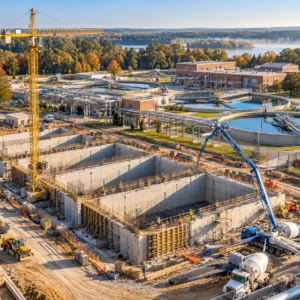
Cost is the issue every utility raises, and the Commerce City setting made the point. The South Adams County Water and Sanitation District completed an $86 million ion exchange plant at its Klein Water Treatment Facility in 2026, able to treat up to 18 million gallons of water per day, according to the Denver Gazette.
EPA’s Office of Water is pursuing public-private partnerships to bring that kind of cost down over time.
“Partnerships are the key to unlocking innovation and next-generation technologies,” said Jess Kramer, EPA’s PFAS lead and Assistant Administrator for the Office of Water. “These partnerships will accelerate technology breakthroughs to reduce PFAS in water while also reducing the cost of treatment to save money.”
For the industry, the practical questions are clear:
- Which pilot sites will host new technologies first
- How performance data will be shared with utilities
- What the Break the Bond Navigator lists for funding and assistance
- When STAR and SBIR solicitations for destruction research open
- How pilot results feed into updated treatment guidance
From Strategy to Installed Capacity
PFAS TECH emphasises collaboration with federal agencies, states, local leaders, industry and technical assistance providers. Its value will be measured by how quickly pilot results become designs that utilities and site owners can specify with confidence.
That is where the market opportunity sits. Vendors with field data will be better placed than those with lab data alone, and utilities planning treatment now will have more evidence to choose from as results come in.
Regulation set the target for PFAS removal. Technology will decide what it costs to reach it.