
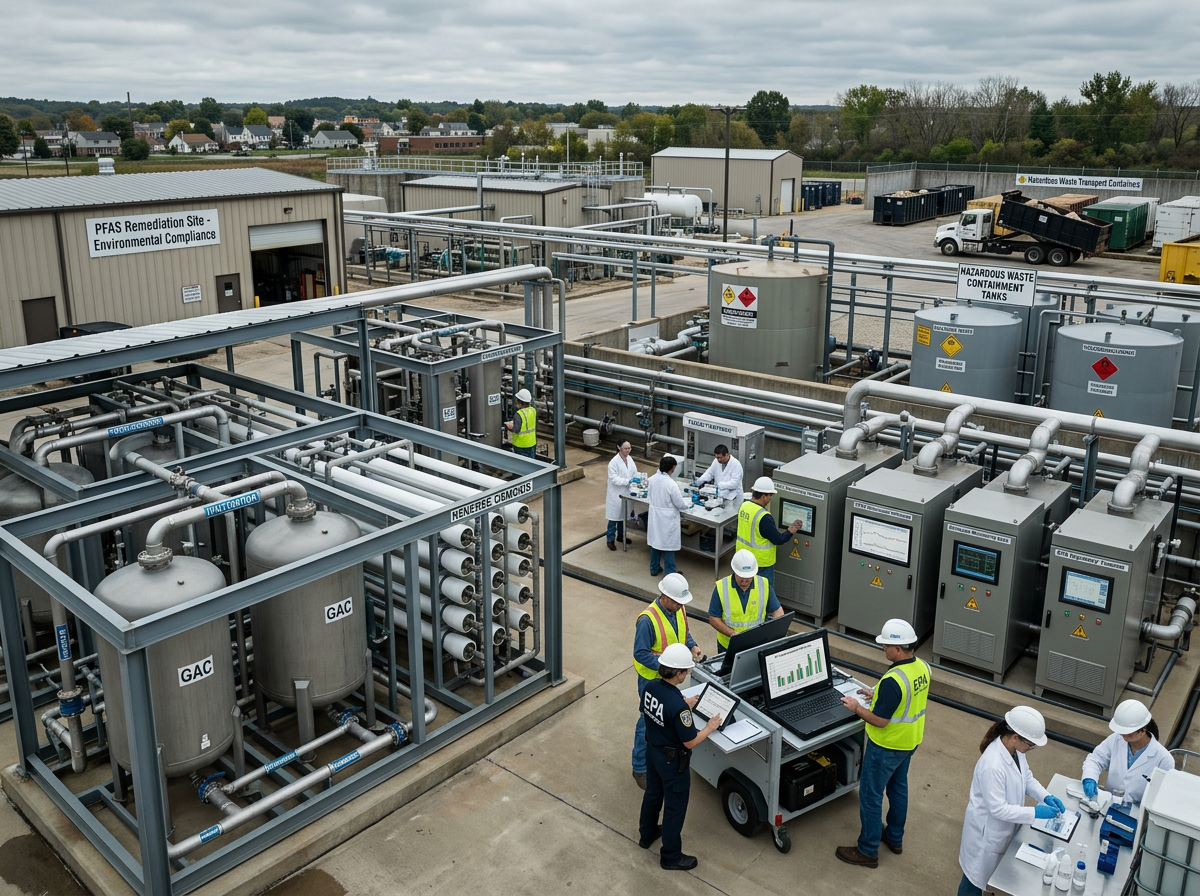
For C-suite executives across the water utility, chemical manufacturing, and waste management sectors, the regulatory landscape for per- and polyfluoroalkyl substances (PFAS) has just been fundamentally restructured. The U.S. Environmental Protection Agency (EPA), in coordination with the Department of Health and Human Services (HHS), has launched a lifecycle-based strategy that simultaneously delays core enforcement deadlines, pulls back legally vulnerable minor-compound rules, and injects immediate infrastructure capital into the market.
This is a deliberate operational pivot toward regulatory durability, economic practicality, and point-of-source industrial liability.
The Strategic Split: Deadlines Delayed vs. Rules Rescinded
The EPA’s dual proposed rules divide existing drinking water standards into two distinct operational tracks, directly impacting corporate risk profiles and capital expenditure timelines.
1. Two-Year Compliance Runway (PFOA and PFOS)
While the agency maintains strict limits for the two primary compounds—PFOA and PFOS—it has conceded to the supply chain and engineering bottlenecks facing the industry. A new non-automatic opt-in process allows eligible water systems to apply for a two-year compliance extension.
- The New Deadline: Approved systems will see the hard enforcement deadline push from 2029 out to 2031.
- Commercial Implication: The EPA explicitly notes that this extension is designed to let technology costs stabilize and decrease through production efficiencies, protecting corporate budgets and consumer rate structures from sudden, unchecked CAPEX spikes. Systems that do not proactively apply remain bound to the 2029 mandate.
2. Procedural Rescission of Four Major PFAS Limits
In a major corrective move, the EPA has proposed to formally rescind existing regulations for four minor PFAS compounds: PFHxS, PFNA, HFPO-DA (GenX), and the combined Hazard Index.
- The Vulnerability: The agency acknowledged that the previous administration violated the Safe Drinking Water Act (SDWA) by simultaneously combining the determination to regulate with the actual proposed limits, denying the public the mandatory sequential opportunity to comment on the threshold question of regulation.
- The Corporate Takeaway: To eliminate ongoing litigation and compliance uncertainty, these rules are being taken off the table. While the EPA intends to re-evaluate these compounds under a legally defensible framework in the future, the immediate compliance liabilities for these specific variations are effectively paused.
Capital Deployment: $1 Billion in Frontline Infrastructure Grants
To mitigate the massive cost of separation and testing infrastructure, the EPA has released $1 billion in immediate grant funding via the Emerging Contaminants in Small or Disadvantaged Communities Grant program. This brings the total allocation under this program to $5 billion over five years.
For project finance officers, this pool is heavily augmented by broader federal financing channels:
- $4 billion allocated through the Drinking Water State Revolving Funds dedicated to emerging contaminants.
- $6.5 billion in low-interest financing available through the Water Infrastructure Finance and Innovation Act (WIFIA) loan program.
This scale of capital injection is explicitly intended to expand the commercial toolkit, generate field performance data, and drive down per-system equipment costs across the market.
Upstream Liability: The “Polluter-Pays” Mandate
For industrial manufacturers and chemical processors, the EPA is aggressively steering away from penalizing downstream “passive receivers” (like municipal utilities) and refocusing liability directly on point-of-source dischargers.
- Industrial Effluent Limits: The EPA is finalizing technology-based effluent limitations and pretreatment standards designed to choke off industrial PFAS discharges before they enter waterways. A formal proposed rule will be issued in the coming months.
- TSCA Reviews: Under the Toxic Substances Control Act (TSCA), the agency is mandating stricter, gold-standard scientific reviews for both new and existing chemical formulations before they can legally enter commercial supply chains.
- Durable Legal Protection: The EPA noted that while internal enforcement discretion protects passive receivers, a permanent statutory fix from Congress is being actively sought to insulate water utilities from third-party legacy cleanup lawsuits.
Scaling the PFAS Destruction Toolkit
As separation technologies concentrate massive volumes of PFAS-laden waste, the corporate waste management sector faces an immediate need for commercial-scale destruction. The EPA has moved its PFAS Destruction and Disposal Guidance to an annual update cycle to rapidly validate and commercialize next-generation thermal and chemical PFAS destruction methods.
The current asset management validation pipeline tracks a clear technical split:
| Separation Technologies (Proven) | Destruction Technologies (Under Study) |
| Granular Activated Carbon (GAC) | Supercritical Water Oxidation (SCWO) |
| Ion Exchange (IX) Resins | Electrochemical Oxidation |
| Reverse Osmosis (RO) Membranes | Hydrothermal Alkaline / Non-Thermal Plasma |
Timeline for Corporate Response
The two proposed rules will trigger a 60-day public comment period upon official publication.
Executive boards, legal counsel, and environmental compliance teams can formally engage with the regulatory record during a virtual public hearing scheduled for July 7, 2026. Public comments will officially close on July 20, 2026.