PFAS destruction now has a clearer instruction manual.
On September 8, UC Riverside reported that its environmental engineers had identified the key chemical reactions that take place when ultraviolet light is used to break down forever chemicals in water. The study, published in Nature Water under the title “Comprehensive Mechanisms and Pathways for PFAS Degradation Under UV Irradiation,” was led by Jinyu Gao with Dandan Rao and corresponding author Jinyong Liu, an associate professor of chemical and environmental engineering.
This is a lab study, not a plant opening. But it tackles one of the quieter bottlenecks in the destruction market. Developers have been scaling UV-based treatment faster than the field has fully understood what happens inside the reactor.
That gap is now narrower.
What the Riverside Team Actually Found
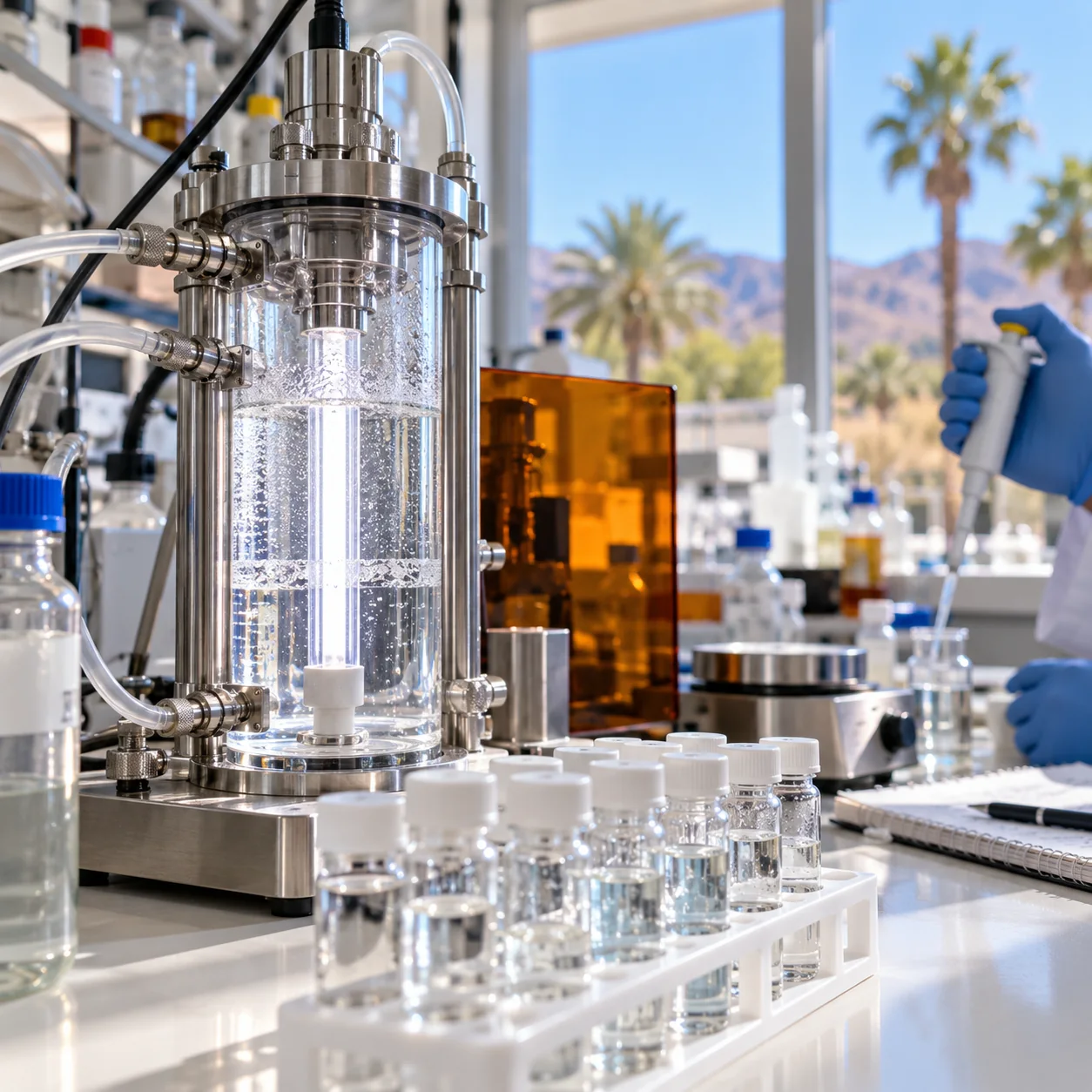
The process studied pairs UV light with sulfite. According to UC Riverside, the combination generates highly reactive electrons that attack PFAS molecules and begin breaking their carbon-fluorine bonds, the bonds that make these compounds so persistent. As those bonds break, fluorine is stripped from the molecule and released into the water as fluoride ions.
The team found that three agents work together: hydrated electrons, hydroxyl radicals and hydroxide ions. The radicals and hydroxide help break carbon-carbon bonds, fragmenting what remains of the molecular chain.
The second finding concerns by-products. The main carbon-containing product during chain shortening is formate, not carbon dioxide as earlier literature had assumed, according to coverage of the paper on Phys.org. The chemistry is more complex than the field had been working with.
“Knowing this degradation mechanism gives us a better understanding of how to optimize the conditions for PFAS destruction and achieve deeper degradation, and gives us a much better roadmap for improving the technology,” Liu said.
Mechanism Is What Turns a Process Into a Product
For technology developers, a paper like this is worth more than another headline destruction percentage. A destruction rate tells a buyer what a system did on one feed under one set of conditions. A mechanism tells an engineer why it worked, and what to change when the feed changes.
That distinction matters because PFAS waste streams vary widely. Ion exchange regenerant, reverse osmosis concentrate, landfill leachate and spent firefighting foam each carry different background chemistry. A developer that knows which reactive species are doing the work can tune its process to support them instead of overdesigning reactors and spending extra energy as a safety margin.
Better mechanism also makes verification simpler. When the expected end products are known, operators and laboratories know what to measure when confirming that a treatment run did what the vendor claimed.
Regulators Are Asking for Exactly This Kind of Evidence
The timing fits federal policy. EPA’s 2026 Interim Guidance on the Destruction and Disposal of PFAS, updated in April, centres on underground injection, landfills and thermal treatment. It also acknowledges that companies and researchers are developing new destruction methods, and it sets out a technology evaluation framework for emerging approaches that emphasizes publicly released data aligned with “gold standard science” principles.
Peer-reviewed mechanistic work is the base that framework needs. Non-thermal technologies have had a harder time competing with incineration partly because buyers and regulators lacked confidence in what came out of the reactor. A published, detailed reaction pathway helps close that confidence gap.
EPA has also committed to updating the guidance annually rather than every three years. That gives emerging technologies a faster route into the official reference as the evidence base grows.
A Message for Chemical Manufacturers Too
Liu framed the work as useful upstream as well. “By knowing the degradation mechanisms, we can give the solid input to the fluorocarbon industry to tell them how to design compounds that can more easily be treated to protect the environment,” he said.
That is an underappreciated opportunity. Most PFAS strategy splits into two camps: restrict and replace at the front end, capture and destroy at the back end. Mechanistic insight connects the two. Fluorochemistry that remains essential in sectors such as semiconductors, medical devices and energy could, in principle, be designed with end-of-life treatment in mind.
Design for destruction is a concept the sector can build on.
Buyers Now Have Sharper Questions to Ask
The study will not change procurement decisions on its own. It does give utilities and industrial operators better questions for anyone selling UV-based or other reductive destruction systems:
- Does the process design account for all the reactive species involved, not only hydrated electrons?
- How is fluoride release managed in downstream water chemistry?
- Which carbon by-products are monitored, and is formate in the analytical plan?
- How consistent is performance across different concentrate and waste feeds?
- Is destruction data published or independently verified, in line with EPA’s evaluation framework?
- What are the energy and chemical inputs per unit of PFAS destroyed?
Investors should read the paper the same way. Companies whose process chemistry matches a peer-reviewed mechanism will find their performance claims easier to defend before regulators and utility engineers.
The destruction market has spent years proving that PFAS can be broken.
The next phase is proving it can be done precisely, predictably and at scale. Riverside has handed the industry part of the map.