For most of the last decade, PFAS remediation was treated as an environmental compliance issue.
That framing is now becoming outdated.
Across Europe and increasingly in the United States, PFAS is evolving into an infrastructure, capital allocation, and industrial risk management issue, particularly for utilities, advanced manufacturing, chemicals, semiconductors, waste management, and water technology providers.
The most important shift is not regulatory rhetoric.
It is the growing realization that conventional PFAS treatment technologies do not eliminate the liability.
They relocate it.
The Industry Is Moving Beyond “Removal”
Granular activated carbon (GAC), ion exchange systems, and reverse osmosis remain the dominant PFAS treatment approaches globally. These technologies are effective at reducing PFAS concentrations in water streams, which explains why they continue to dominate municipal and industrial deployments.
But they also create concentrated waste streams that require transport, regeneration, destruction, or long-term disposal.
That secondary liability is becoming commercially significant.
As regulatory scrutiny increases across Europe and the US, utilities and industrial operators are beginning to evaluate PFAS technologies differently. The key procurement question is no longer simply:
“How efficiently can this system remove PFAS?”
It is increasingly:
“What downstream liability does this treatment process create over the next 10 to 20 years?” That shift is quietly reshaping the market for PFAS destruction technologies.
Why Europe Is Funding Electrochemical PFAS Destruction
One of the clearest signals comes from the EU-backed FOREVER-WATER initiative, which is evaluating electrochemical oxidation systems incorporating advanced conductive materials, including graphene-derived electrode structures, for treatment of PFAS-contaminated groundwater and industrial wastewater.
The significance is not that graphene itself is suddenly becoming a commercial PFAS solution.
The significance is that Europe is actively funding technologies designed to reduce dependence on long-term PFAS waste handling infrastructure.
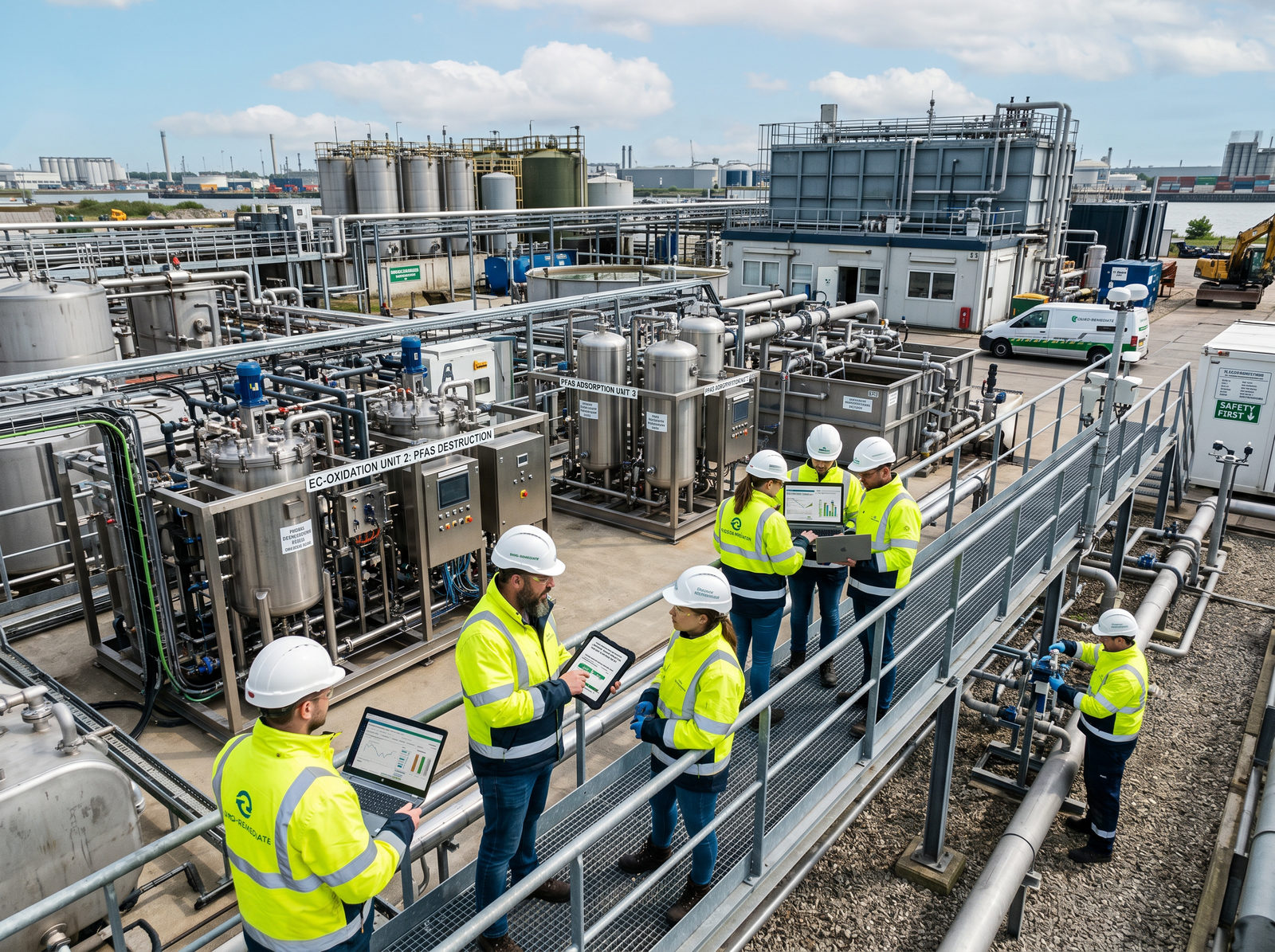
Electrochemical systems aim to degrade PFAS molecules directly rather than simply concentrating them into another disposal stream. While these technologies remain in pilot and validation stages, they represent an important strategic direction for the industry.
From an executive perspective, this matters because it changes where long-term value may emerge across the PFAS ecosystem.
Historically, the market favored companies specializing in:
● adsorption media,
● filtration systems,
● and membrane separation.
The next phase may increasingly reward companies capable of:
● reducing destruction costs,
● minimizing secondary waste,
● lowering transportation liabilities,
● and integrating destruction technologies into industrial wastewater infrastructure.
Europe’s Regulatory Environment Is Accelerating the Transition
The timing is not coincidental.
The EU Drinking Water Directive now requires expanded PFAS monitoring obligations across member states, while broader PFAS restrictions under REACH continue advancing through the European regulatory process.
This combination is beginning to alter capital planning decisions across several industries.
For utilities, PFAS treatment is becoming a long-duration infrastructure investment rather than a temporary compliance upgrade.
For industrial operators, PFAS exposure is increasingly tied to:
● future remediation obligations,
● operational permitting,
● waste management costs,
● and investor scrutiny around environmental liabilities.
For technology providers, this creates a more important strategic reality:
The market is gradually shifting from episodic remediation projects toward permanent PFAS management infrastructure.
That distinction affects everything from procurement cycles to M&A strategy.
Semiconductor Manufacturing May Become the Defining PFAS Battleground
One area executives should watch closely is semiconductor wastewater.
Modern semiconductor fabrication relies heavily on fluorinated chemistries across etching, cleaning, and process applications. At the same time, Europe is pursuing both semiconductor expansion and stricter PFAS regulation.
Those priorities are increasingly intersecting.
This creates pressure for advanced wastewater treatment systems capable of handling concentrated PFAS streams without generating escalating disposal liabilities.
That is one reason electrochemical destruction technologies are attracting attention despite their current technical and economic limitations.
High-strength industrial waste streams are often more commercially viable for advanced destruction technologies than dilute municipal water systems.
In other words, the earliest scalable economics for PFAS destruction may emerge in industrial manufacturing before municipal deployment.
The Market Opportunity Is Larger Than Water Treatment Alone
Many companies still view PFAS primarily through an environmental services lens. That may underestimate the scale of the coming market transition.
PFAS infrastructure now intersects with:
● industrial permitting,
● advanced manufacturing resilience,
● waste logistics,
● municipal capital expenditure,
● ESG reporting,
● insurance exposure,
● and long-term asset risk.
This is why major infrastructure and environmental players are increasingly positioning themselves around integrated PFAS management rather than standalone filtration products.
The strategic opportunity is no longer confined to contaminant removal. It increasingly involves ownership of the broader PFAS lifecycle:
● detection,
● concentration,
● destruction,
● waste handling,
● compliance monitoring,
● and long-term liability reduction.
What Executives Should Be Watching Over the Next 24 Months
The key question is not whether electrochemical PFAS destruction works in laboratory conditions.
It does.
The real commercial questions are:
● Can these systems operate continuously at industrial scale?
● Can they reduce lifecycle costs versus disposal-heavy treatment models?
● Can they achieve regulatory acceptance across multiple jurisdictions?
● And can they integrate into existing industrial water infrastructure without major operational disruption?
The companies that answer those questions first may shape the next phase of the PFAS infrastructure market.
Because the industry is moving toward a new reality:
Capturing PFAS is no longer enough.
Reducing long-term liability is becoming the real product.