A transformer fire is put out in hours. The PFAS left behind can linger for decades.
A cleanup at a UK electrical substation suggests it does not have to. According to a November 17, 2026 announcement from REGENESIS, environmental response firm Adler & Allan recorded an average 99.68% reduction in total PFAS mass in a substation drainage network after a major transformer fire and the firefighting foam release that followed. PFAS levels fell below assessment criteria, and stormwater discharge from the site was reinstated.
The work won the Inland Responder, Large Incident award at the 2026 UK & Ireland Spill Association Annual Awards, entered jointly with National Grid Energy Transmission, and was shortlisted for Best Application of Remediation Technologies at Environment Analyst’s 2026 Brownfield Awards.
For asset owners who store or use foam, the case offers something rare: a full sequence, from emergency to discharge permit, with a number at the end.
From Fire Ground to Clean Drains
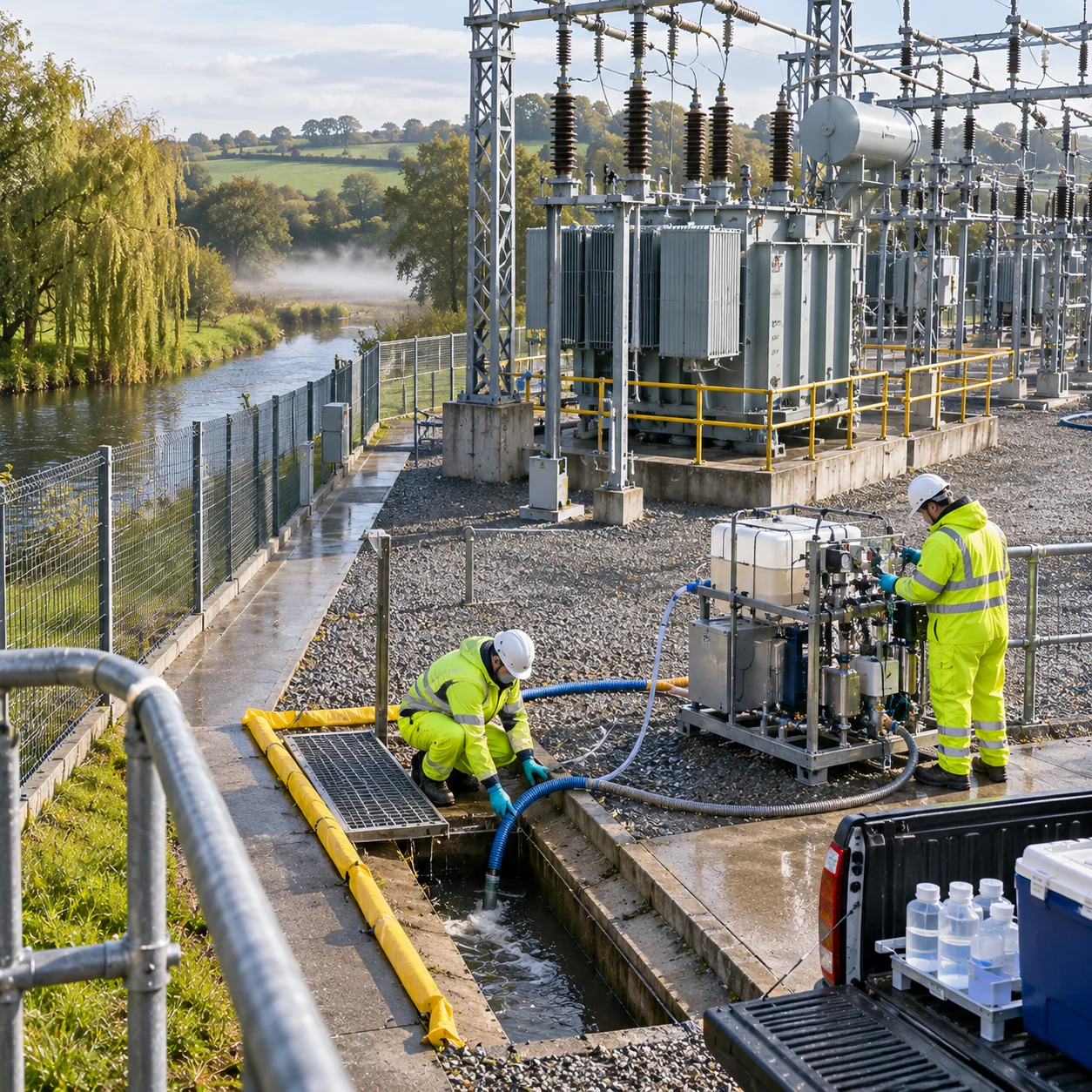
The response ran in two phases. In the emergency phase, crews isolated the stormwater network, contained and removed contaminated firewater, and monitored the adjacent river, according to REGENESIS.
The second phase dealt with what containment could not remove. After the drainage network was cleaned and repaired, Adler & Allan applied PlumeStop, a patented colloidal activated carbon from REGENESIS, to bind residual PFAS in place. REGENESIS supplied the product and advised on its use before application.
Crews flushed and sprayed the material through drainage and other affected infrastructure, then ran flushing and uplift cycles to clear contamination. The company says the approach also reduced the risk of PFAS migrating over the long term.
That second step is the one most incident plans leave out.
Why Infrastructure Holds the Problem
Aqueous film-forming foam is designed to spread and coat. When it hits a substation, a refinery or an airfield, it does not stay on the surface. It moves into pipes, gullies, interceptors and the fine cracks of concrete, where residual PFAS can keep leaching into stormwater long after the visible foam is gone.
That turns a one-day emergency into a recurring discharge problem. Operators can face months of tankered water, blocked outfalls and repeated sampling while they work out how to get their drainage system back into service.
Gareth Leonard, executive vice president of global sales and services at REGENESIS, said the approach gives clients another option to consider when planning remediation after a firefighting foam release, with an emphasis on first identifying how those chemicals could move through a site.
The Same Chemistry Is Working Underground
Colloidal activated carbon is not new to PFAS work, and the substation case adds a surface infrastructure application to a growing record in groundwater.
In August 2026, REGENESIS reported that a PlumeStop barrier at a former fire training facility in Barnstable County, Massachusetts, had earned the National Ground Water Association’s 2026 Outstanding Groundwater Remediation Project Award. That site sits within a public water supply protection area and a sole source aquifer, and decades of foam use had contaminated its soil and groundwater.
Barnstable County, GZA GeoEnvironmental and REGENESIS installed a 617-foot in situ permeable adsorptive barrier, injecting more than 600,000 gallons of PlumeStop solution, with full-scale installation completed in 2025. According to the release, regulatory compliance for PFAS was achieved within 90 days, and 18 downgradient performance wells showed a 99% reduction in the six PFAS compounds regulated in Massachusetts. The county’s existing pump-and-treat system costs roughly $450,000 a year.
Two very different sites. One consistent result.
What Asset Owners Should Take From It
Utilities, airports, fuel terminals and industrial sites that hold foam stocks can use the substation case to sharpen their own response plans. The practical lessons include:
- Map drainage routes and outfalls before an incident, not during one
- Pre-agree how firewater will be isolated, contained and removed
- Plan river or receiving water monitoring from the first hour
- Treat cleaned drainage as a remediation zone, not a closed issue
- Set clear assessment criteria so discharge can be reinstated on evidence
- Keep remediation contractors and product suppliers on standby agreements
Grid operators have particular reason to pay attention. Substations often sit close to rivers, farmland and communities, as this one did beside a monitored river. A credible plan for the days after the fire protects both the environment and the operator’s ability to keep the site running.
From Emergency Response to Standard Practice
PFAS remediation is often discussed in terms of decades and billions. The substation case is smaller and faster, and that is its value. It shows that a single incident can be contained, cleaned and closed out with measurable results, using materials already proven in groundwater.
Will foam incident plans start to include in situ treatment as a standard step?
Will regulators begin to expect evidence of residual PFAS treatment before discharge is reinstated?
Both would move the industry from cleanup after the fact toward containment by design.
Putting out the fire is the first job. Keeping the foam from becoming the next problem is the second.